
Faulty Rainwater Goods – Common Property Defects #4
Saturday, 5th December 2015
Common Property Defects | Surveying
A common cause of dampness in residential properties is defective rainwater goods; namely gutters and downpipes. The Building Research Establishment (BRE) estimate that a staggering 1 in 5 houses have defective rainwater disposal systems.
Most modern gutters and downpipes are formed of PVC. Older units tend to be formed of cast iron, and it is quite common to find cast iron downpipes still in situ in older properties even after the gutters have been replaced with PVC. Iron is vulnerable to corrossion. It is often found that issues materialise at the back of cast iron downpipes, which have been neglected during previous cycles of external maintenance, and may have gone decades without being painted.
Gutters will overflow if they are not of sufficient capacity to cope with the volume of water discharged from the roof (commonly in periods of heavy rain or on particularly large roofs). Gutters are also vulnerable to blockage by leaves, moss and other foliage causing water to back up and overflow, saturating the external walls below.
The saturation of external walls is a distinct problem in older properties, where the walls are of solid masonry construction. When a solid wall become saturated, the dampness can permeate internally, causing damage to decorations and potentially compromising other elements of the building. The saturation of an external wall will often also causes frost damage, resulting in spalled brickwork and damaged pointing, which will increase the porosity of the wall and further exacerbate the damp issue.
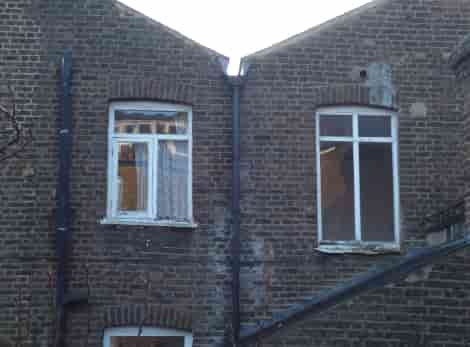
The staining on the rear wall of this Victorian property was caused by the hopper beneath the box gutter of the main roof overflowing during periods of heavy rain. Internally, penetrating damp was present beneath the left-hand window.
Valley gutters (which run at the intersection of two roofs) and box gutters (which run at the centre of inverted pitch roofs) are particularly vulnerable to failure. Both are typically formed of lead, which requires appropriate detailing to ensure weather-tightness and to allow for thermal movement. Failure of a valley gutter or box gutter can result in water penetrating directly into the roof space, particularly if the sarking felt is compromised or, worst of all, if there is no felt at all. The BRE estimates that 1 in 12 box gutters are defective.
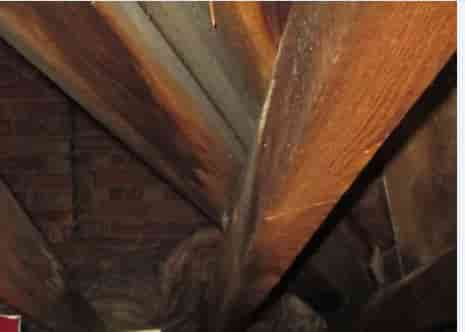
The discolouration of the valley board and adjacent rafter in this roof space was caused by moisture penetration following failure of the lead valley gutter due to thermal movement. Left longer, the problem could have resulted in a serious attack of rot or beetle infestation, requiring the replacement of the affected timbers.
If you have noticed damp issues in your property, and are unsure of the cause, our team of Chartered Surveyors will be happy to help. You can call the team on 020 7183 2578, or send us an email.


