
Rear Extensions and the Party Wall Act
Friday, 20th February 2026
Party Walls
This is a follow up to a recent post covering loft conversions and specifically which aspects of the work fall within the scope of the Act. In this post, we’re going to look at rear extensions from the same perspective.
The construction of a typical rear extension will often require an owner to exercise rights under 3 separate sections so the Act.
Excavation
A new ground-based extension will typically be constructed on new foundations. There are many types of foundation but, by far the most common, are trench fill mass concrete foundations.
The depth of foundations in London and surrounding areas has gradually increased over time and are now generally a minimum of 1.0m deep. The final depth depends upon the quality of the ground and the proximity of any trees and is for the Building Control officer to determine.
Excavation comes within the scope of section 6(1) of the Act if it is within 3.0m of an adjoining or shared structure and deeper than the base of the foundation to that structure.
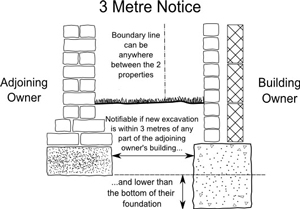
If the ground is of poor quality, the engineer may decide that another type of foundation, such as piles, would be more appropriate. If the piles are more than 3.0m deep, which is very common, that could bring section 6(2) of the Act in to play. This extends the notifiable radius to 6.0m but the other part of the criteria is more complicated – the excavation would have to cut through a 45 degree plain extending down from the base of the outside edge of the foundation to an adjoining/shared structure. This is easier to understand by looking at a diagram:

Works of this type are set out on a Notice of Adjacent Excavation and the statutory notice period is 1 month.
New wall at the boundary
Owners are generally keen to construct the flank wall of their extension either up to or astride the boundary as it makes the internal floor area of the extension as large as possible.
The right to build up to the boundary is provided by section 1(5) of the Act and is available to all owners. The right to build astride boundary (meaning equally on each owners’ land) is provided by section 1(2) of the Act but requires the express consent of the adjoining owner. If that consent is not forthcoming, there’s no need to serve a further notice, so it’s always worth asking.
New walls built astride the boundary will be defined as party walls and may be enclosed upon by the adjoining owner at a later stage (subject to serving notice and contributing towards the cost of building the wall).
Works of this type are set out on a Line of Junction Notice and the statutory notice period is again 1 month.
Changing the ground floor arrangement
When an owner extends their property, they will often change the layout of the ground floor to make the most of the additional space e.g. to make it open plan. This may include cutting the rear wall, or internal walls, away from a party wall. This is a right provided by section 2(2(g) of the Act.
Works of this type are set out on a Party Structure Notice and the statutory notice period is 2 months.
If you are planning a rear extension and require advice on party wall matters, you are welcome to contact us on 020 7183 2578 or via email. We can also prepare and serve the notices on your behalf for a flat fee of £75 plus VAT per adjoining owner.


